
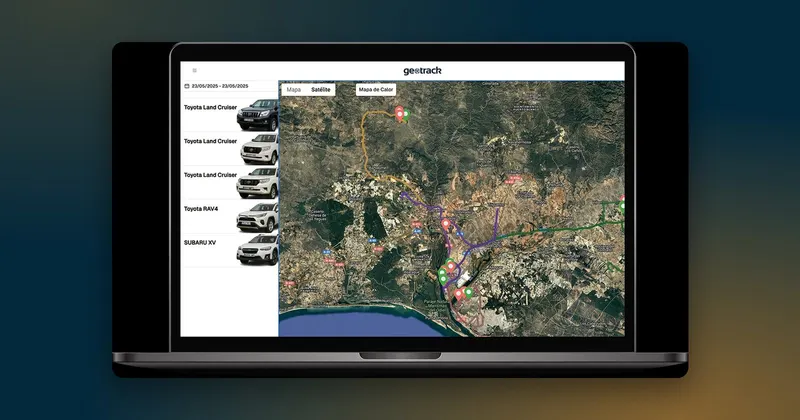
Fitting a GPS tracker to company vehicles is legal, but it is not enough to install it and start watching the map. As soon as an employee drives the vehicle, knowing where the vehicle is also means knowing where that person is, and that falls squarely within data protection. This article explains what the law says, what you must tell people before switching it on, what limits the Spanish Data Protection Agency (AEPD) sets and which mistakes are best avoided.
What the law says about geolocation at work
The reference rule is Organic Law 3/2018 (Ley Orgánica 3/2018, Spain's Personal Data Protection and Digital Rights Act, known as the LOPDGDD). Its Article 90 allows employers to process data obtained through geolocation systems in order to exercise the monitoring functions granted to them by the Workers' Statute (Estatuto de los Trabajadores, Spain's main employment law), always within its legal framework and subject to its limits.
That framework is Article 20.3 of the Workers' Statute, which allows the company to adopt surveillance and monitoring measures to check that employees are fulfilling their obligations, "with due regard to their dignity when adopting and applying them".
Article 90 itself adds the condition that is most often overlooked: before using the system, the company must inform employees and, where applicable, their representatives, expressly, clearly and unambiguously, that the device exists and what it is like. It must also inform them that they can exercise their rights of access, rectification, restriction of processing and erasure.
In addition, if the company has a works council, Article 64.5.f) of the Statute gives it the right to issue a prior report on the introduction and review of work organisation and monitoring systems. And Article 91 of the LOPDGDD opens the door for the collective agreement to add safeguards of its own, so check yours.
Consent is not required, but informing is
It is a common misunderstanding to think that each driver has to sign a consent form. The AEPD guide Data protection in employment relationships (La protección de datos en las relaciones laborales) makes this clear: the legal basis for the processing is not consent, but the employment contract and the monitoring powers that the law gives the employer.
What is mandatory is prior information. A good notice to staff should make clear, as a minimum:
- Which vehicles carry a tracker and since when.
- What the data is used for: organising services, protecting vehicles against theft, justifying mileage, monitoring costs…
- What data is recorded (position, routes, stops) and who in the company can view it.
- How long it is kept.
- What happens outside working hours if the vehicle is also used for personal purposes.
- How to exercise the rights of access, rectification, restriction and erasure.
The AEPD also advises that the information should appear in a prominent place in each vehicle, in the driver's line of sight. A sticker on the dashboard costs little and avoids arguments.
The limits set by the AEPD
The fact that the system is legal does not mean that any use is acceptable. The AEPD guide sets out several principles that are worth keeping in mind from day one.
Purpose and minimisation
The data is used for what you said it would be used for. The guide's own example: if geolocation is used for the working time record, the data cannot be used to check the employee's location at every moment, but only the start and end times of the activity.
Proportionality
The AEPD asks that these systems be limited to situations in which there are no less intrusive means. It gives goods transport as a justified example, where it matters to know where the vehicle is and when it will be able to make a delivery, and it warns that this does not justify giving a device of this kind to the whole workforce if their job does not require it.
The vehicle, not the person
The guide reminds us that vehicle trackers are there to follow the vehicle, not to monitor drivers' behaviour or whereabouts. Even so, it acknowledges that locating the tool ends up locating the person using it too, and for that reason it calls for caution.
Personal use of the vehicle and time outside working hours
This is where most conflicts arise. If the employee may use the company car for personal purposes, the AEPD's main proposed measure is that they should be able to temporarily disable tracking when there are circumstances that justify it, such as going to the doctor.
The guide also cites a ruling of the High Court of Justice of Asturias (STSJ AS 4125/2017) that required the company to ensure the device was not operational once the working day had ended, because the employer's power of control ends with it.
If you have a legitimate reason to know the location outside working hours, such as preventing theft, the means used must be proportionate. The AEPD gives the example of consulting the data already stored only when there is a specific reason, and not at all times.
In practice, decide on one of these options in writing and explain it in the notice:
| Situation | What to do |
|---|---|
| The vehicle is only used during working hours and stays at the base | Inform staff and use the data for the stated purposes. |
| The employee takes the vehicle home but may not use it for personal purposes | Put it in writing and limit consultation outside working hours to specific reasons, such as theft. |
| Personal use is permitted | Consider how to disable tracking, or not consult it, during that time, and explain it in the notice. |
Common mistakes
- Installing first and informing afterwards. The information must come beforehand. Data obtained without notice may not be valid in disciplinary proceedings.
- Using the data for something that was not communicated. If you said the tracker was for organising routes, do not suddenly use it for something else without informing people first.
- Giving everyone access. Limit who can view the map and the history. There is no need for the whole office to see where each driver is.
- Forcing staff to use their personal mobile. The AEPD considers it unlawful to require employees to provide their own equipment, such as their phone, to be geolocated.
- Keeping data indefinitely. Set a retention period according to the purpose and stick to it.
- Forgetting the representatives. If there is a works council or staff delegates, inform them and review the collective agreement.
If the system is new to your company, the AEPD recommends carrying out an impact assessment before introducing it. For any specific doubt, consult whoever advises you on data protection or the AEPD's own website.
How Geotrackr fits in
With Geotrackr, each vehicle has a GPS tracker installed and the company checks its position on the map from the Android and iOS app or from the web panel. The system locates the vehicle, not the driver's phone, so nobody has to use their personal mobile for it to work.
As well as real-time location, it stores the route history with stops and refuelling, which helps you justify mileage, check a job or review an expense. What the tool does not do for you is decide what you are going to use that data for or notify your staff: that is up to you, and with what you have read here you now know where to start. If you still have questions about how it works, you will find the most common answers in the frequently asked questions.