Many haulage companies ask the same question: if the lorry already has a tachograph, and the new tachographs store the vehicle's satellite position, why do you need a GPS tracker? Or the other way round: if you have a tracker, can you do without the tachograph? The short answer is that they are two devices with different purposes, and neither replaces the other. This article explains what each one does, what the regulations say and how they complement each other.
What a tachograph is for
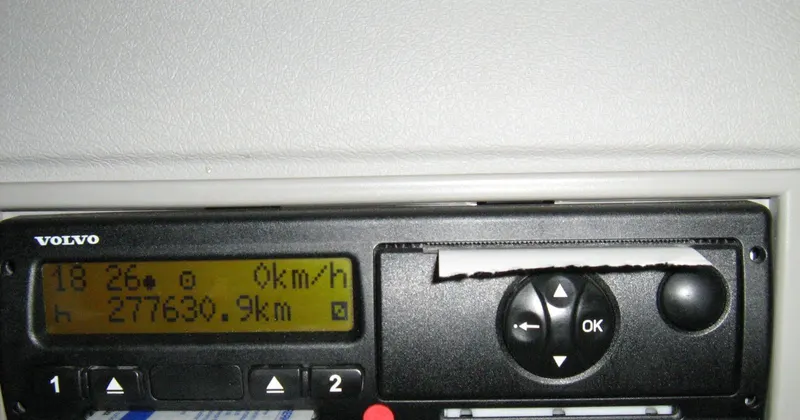
The tachograph is a mandatory control device. Regulation (EU) No 165/2014 sets out the obligations for its manufacture, installation, use and control, and its purpose is to check compliance with, among other rules, the driving time and rest period rules of Regulation (EC) No 561/2006.
What it records is designed so that an enforcement authority can check how much each driver has driven, when they have rested and whether they have kept within the limits. That is why it works with personal cards: the driver card, the company card, the workshop card and the control officer card.
Which vehicles it applies to
Regulation 561/2006 applies, in general, to road transport:
- Of goods, where the maximum permissible mass of the vehicle, including any trailer or semi-trailer, exceeds 3.5 tonnes.
- Of passengers, in vehicles constructed or permanently adapted to carry more than nine people, including the driver.
Regulation (EU) 2020/1054 added a further case: from 1 July 2026, goods vehicles over 2.5 tonnes, including the trailer, when carrying out international transport or cabotage. If you have large vans that leave Spain, check whether this affects you.
The regulation itself provides for exceptions for certain vehicles and activities. If you have doubts about a specific vehicle, consult the text or ask the transport department of your autonomous community.
The smart tachograph also stores the position
This is where much of the confusion comes from. Since the reform introduced by Regulation 2020/1054, Article 8 of Regulation 165/2014 states that the smart tachograph automatically records the vehicle's position at these points:
- The place where the daily working period begins.
- Every time the vehicle crosses the border of a Member State.
- Every time it carries out loading or unloading operations.
- After every three hours of accumulated driving time.
- The place where the daily working period ends.
In other words, the tachograph stores specific points to make enforcement easier, not the complete route. In addition, Article 7 of the same regulation restricts the use of that data: Member States must ensure that it is processed only to check compliance with the rules listed in the regulation.
What a GPS fleet tracker is for
A GPS fleet tracker is a management tool. No transport regulation requires it; the company installs it because it helps with organisation. It is typically used to:
- See where each vehicle is right now.
- View the complete route for a day, with its stops.
- Justify mileage or verify a service for a customer.
- Monitor refuelling and the costs of each vehicle.
- Locate a stolen vehicle.
And it works for any vehicle, whether or not it has a tachograph: cars, vans, tractors, motorbikes.
The differences at a glance
| Tachograph | GPS fleet tracker | |
|---|---|---|
| Is it mandatory? | Yes, for vehicles covered by Regulation 561/2006. | No. The company decides. |
| What it is for | Monitoring driving times, rest periods and other transport rules. | Managing the fleet: location, routes, costs. |
| What it stores about position | Specific points (start and end of the working day, borders, loading and unloading, every three hours of driving). | The route and position of the vehicle, depending on the system. |
| Who can access it | The company and enforcement officers, using their cards. | The company, through its application. |
| Inspection | Periodic inspection at an authorised workshop at least every two years (Article 23 of Regulation 165/2014). | As specified by the provider. |
Common mistakes
- Thinking the tracker replaces the tachograph. It does not: if the vehicle is required to have a tachograph, it must be fitted and used correctly, whether or not there is a tracker.
- Using the tachograph as a day-to-day management tool. Its data serves a different purpose and does not give the complete route.
- Forgetting the company's tachograph obligations. Article 33 of Regulation 165/2014 makes the company responsible for training drivers in its correct use, checking that they use it properly and keeping the records.
- Not informing drivers about the tracker. The tachograph is a well-known legal obligation; the tracker is a company monitoring measure and requires prior notice, as set out in Article 90 of Ley Orgánica 3/2018 (Spain's Organic Law on data protection).
How they complement each other with Geotrackr
Geotrackr is not a tachograph and does not replace one. It is a fleet management platform: each vehicle carries its own GPS tracker and you see its real-time position on the map, from the Android and iOS app or from the web panel.
It also keeps the route history of each vehicle, with stops and refuelling at their exact location, and a downloadable report for each route. This is the complete route that the tachograph does not give you, useful for verifying a service or justifying mileage. It works for lorries and coaches, and also for the vans, cars and tractors that do not have a tachograph. And in the fleet documentation section you can store cards and any other documents with their expiry date, so you are alerted before they expire.