In a fleet with vehicles of different types and ages, each one goes through the ITV (Spain's mandatory periodic vehicle inspection) on a different schedule: some every two years, others every year and some every six months. If you keep track by eye, sooner or later a date will slip. This article summarises the intervals set by the regulations for the vehicles most commonly found in a company, how they are counted and what to do so that no inspection catches you by surprise.
Which regulation governs the ITV
Vehicle technical inspections are regulated by Real Decreto 920/2017, of 23 October (the Spanish royal decree regulating the technical inspection of vehicles). Its article 6 sets the frequency of periodic inspections according to the vehicle's category and age. Age is counted from the date of first registration or entry into service recorded in the Vehicle Register of the Dirección General de Tráfico (Spain's national traffic authority), which appears on the vehicle registration document.
The categories are identified by letters: M for passenger vehicles, N for goods vehicles, L for motorbikes and mopeds, O for trailers and T for agricultural tractors. Each vehicle's category appears on its ITV card.
Intervals by vehicle type
These are the frequencies in article 6.1 for the vehicles most commonly seen in companies:
| Vehicle | Frequency by age |
|---|---|
| Cars (M1, up to 8 seats plus the driver) | Exempt up to 4 years; every two years from 4 to 10 years; annual from 10. |
| Vans and goods vehicles up to 3.5 t (N1) | Exempt up to 2 years; every two years from 2 to 6 years; annual from 6 to 10; every six months from 10. |
| Lorries over 3.5 t (N2 and N3) | Annual up to 10 years; every six months from 10. |
| Trailers and semi-trailers (O2, except caravans, O3 and O4) | Annual up to 10 years; every six months from 10. |
| Buses and minibuses (M2 and M3) | Annual up to 5 years; every six months from 5. |
| Motorbikes, tricycles, quadricycles and quads (rest of L) | Exempt up to 4 years; every two years from 4. |
| Mopeds (L1e) | Exempt up to 3 years; every two years from 3. |
| Agricultural or forestry tractors over 40 km/h | Exempt up to 4 years; every two years from 4 to 16 years; annual from 16. |
| Other agricultural tractors, self-propelled machinery (except single-axle), special trailers and tractor-carriers | Exempt up to 8 years; every two years from 8 to 16 years; annual from 16. |
Some cases have their own intervals. Cars used as taxis, ambulances or for school and children's transport take the ITV every year up to 5 years old and every six months after that. Driving school vehicles are exempt up to 2 years, have an annual inspection from 2 to 5 years and a six-monthly one afterwards. Mixed-use vehicles follow the frequency of the N category that applies to them, and quads are treated like the rest of category L.
The table is a summary. If you have special vehicles, construction and service vehicles or historic vehicles, check the full text of article 6 in the BOE (Spain's official gazette).
How the date of the next ITV is calculated
Article 6.5 explains how validity is calculated: the applicable frequency is added to the date on which the inspection was passed. For example, if a six-year-old car passes the ITV on 10 March, its next inspection falls due two years later.
There is a rule worth knowing: if you take the inspection within the 30 calendar days before the previous one expires, the new validity period is counted from that expiry date and not from the day you took it. In other words, bringing it forward by up to a month doesn't lose you any days.
Also keep in mind the changes of age band. When a vehicle gets older and its frequency changes, for example a van that passes 6 years or a car that passes 10, the next ITV comes round sooner. It is a common mistake to keep thinking in terms of the previous interval.
When it has to be done ahead of schedule
Article 6.7 lists situations in which an inspection can be required before the scheduled date:
- After an accident or another event that has damaged safety components of the steering, suspension, transmission, brakes or chassis.
- When safety or environmental protection components or systems have been modified, in accordance with the vehicle modification regulations.
- When the authorities have a well-founded suspicion that the vehicle does not meet the technical conditions to be driven safely.
- When a change of use or purpose requires a stricter frequency, for example a car that starts to be used as a taxi.
What happens if you miss the date
Article 76.o) of the Ley sobre Tráfico, Circulación de Vehículos a Motor y Seguridad Vial (the Spanish law on traffic, motor vehicle circulation and road safety, Real Decreto Legislativo 6/2015) classes infringements of the rules governing technical vehicle inspection as serious. In addition, an expired ITV can cause you problems with your insurance in the event of a claim, depending on what your policy says. Article 6 itself provides that, if officers detect a vehicle without a valid inspection, they give it a period to pass it, and that if this is not shown, Tráfico can start deregistration proceedings ex officio, in addition to any penalty that applies. The amount of the fine is set by traffic regulations; if you need the exact figure, check the DGT website.
For a company, the most visible cost is usually something else: the vehicle that can't go out on the day you need it, or the time lost looking for an appointment in a hurry.
How to avoid missing any date
- Make a list of the fleet with registration number, category, date of first registration and ITV expiry date.
- Work out the next frequency for each vehicle, taking into account whether it is about to change age band.
- Set a reminder with plenty of margin, at least a month, to book an appointment and take advantage of the 30-day rule.
- Do a pre-check of lights, tyres, brakes and windscreen wipers to avoid a failed result over something simple.
- Update the date as soon as the vehicle passes the inspection, and keep the report.
The same goes for the rest of the documents with an expiry date: insurance, transport cards, permits or authorisations.
How Geotrackr helps
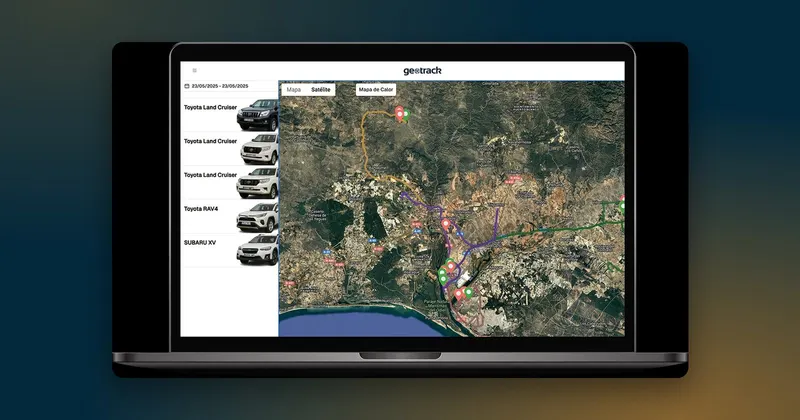
Geotrackr's document management stores the insurance, ITV, cards and any other document for each vehicle with its expiry date, and alerts you before it expires. That way you have the paperwork for the whole fleet in one place and don't depend on a spreadsheet that nobody checks.
If a vehicle needs a repair before the inspection, the invoice is allocated to that vehicle in its expenses and cost per kilometre. And it works for cars, vans, lorries, buses, motorbikes, tractors and agricultural equipment, each with its own documentation.